
Just a quick post today as I go back to a principle I’ve been on the verge of forsaking, that making/serving a big, massive dessert is almost always a mistake. Much, much better to make small, individual portions that are easy to serve and that don’t overload people. I let myself get sucked into making that huge three-layer carrot cake for the Easter dinner, and, while I enjoyed the challenge, in the end I decided it just wasn’t worth it. People were very appreciative of my wonderful dinner and ate a lot, so then that massive (I know I keep using that word) cake was

 On to the next fad diet floating around out there! Remember, you don’t need me yammering at you in order to be able to evaluate these ideas. There are very, very simple things to look for:
 All calories count, but they don’t all count the same, I said in my last post. So I ended with the horrible prospect of how many grams of sugar are in a 32-ounce Big Gulp regular soda. (At some point I’ll take on the diet soda industry, but not today.) 72 grams of sugar all dumped into the bloodstream at once constitute an EMERGENCY. Remember, these liquid sugar calories basically pass right through the stomach and into your small intestine where they’re absorbed. Alarm bells are going off and your pancreas is pumping out insulin at a mile-a-minute clip. And the system is proactive as well as reactive; your digestive system doesn’t wait for nutrients to hit it before swinging into action.
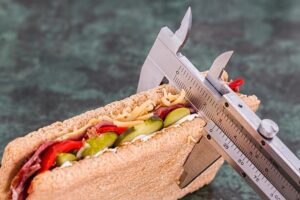 Nothing stays in Vegas. That’s our starting point here: that every calorie you consume has to get used or disposed of by your body in some way. No calories simply disappear into thin air (although they may disappear somewhere else, as noted below). No calories are “free.” Every single molecule you eat must be dealt with. Your body doesn’t function like a car’s gas tank, when there’s an absolute limit of capacity that results in gasoline on the ground (and the gas station owner yelling at you) if you keep trying to outwit the automatic shutoff by “topping off” the tank and manually restarting the pump. Your esophagus doesn’t have an automatic shutoff valve. I’m not even sure where that organ would be best situated: above the larynx? Halfway between the mouth and the stomach? There’d be a food backup, I guess. Kind of gross, and maybe dangerous. You certainly can get into the “I can’t eat another bite” mode, but in reality the stomach’s capacity is very flexible and expandable. (Just ask the people who’ve had stomach-reduction surgery that leaves them with a greatly diminished stomach pouch. If they’re determined enough, they can outwit the surgery, either by eating constant small meals that don’t overstrain the new little pouch or by going ahead and eating too much. The pouch can stretch, eventually. Read about this and other dangers of the surgery at “
 Ah, the wonderful world of so-called “healthy” or “alternative” sweeteners! A food blog that I follow faithfully,