I find that I cannot resist sharing with you the success I’ve had with my version of whole-wheat bagels. I had tried a New York Times recipe awhile back and the results were, shall we say, underwhelming. They tasted fine, but they certainly weren’t bagels. More like flat little pillows, with basically no crust. Bah! I said at the time that I thought the basic problem was that my dough was too soft to hold its shape, especially during the boiling phase, and it turned out that I was right. One of the distinguishing characteristics of bagel dough is that it’s quite stiff, almost to the point of being dry. So take note in the recipe of the guidelines for how sticky (or rather non-sticky) the dough should be.
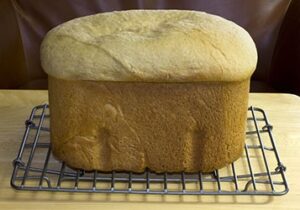 As I’ve been working on the chapter on bread in my planned forthcoming cookbook (when it will come forth is very much an open question), I got inspired to make a bread-machine loaf, something I don’t usually do. My breadmaking usually falls into much more controllable territory–rolls, pizza dough, breadsticks, and overnight bread baked as a round. I don’t have to worry about whether or not rolls are going to cave in, as they are baked outside of the machine. I can eyeball how far they’ve risen and adjust accordingly. But a big loaf is inherently much more unstable, and you can’t tweak the machine’s cycle after it has started. Here it is, though. I was reminded of a passage from Louisa May Alcott’s Eight Cousins, in which the orphan Rose is raised by her Uncle Alec. She takes housekeeping lessons from one of her aunts as a part of her education, and here’s how her baking lessons come out:
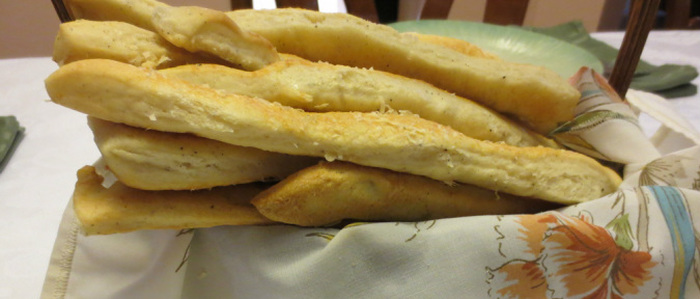
 Although I am trying to stay away from most refined carbs, that avoidance doesn’t mean that I can’t eat bread. I just eat good bread! I’ve ranted and raved about the joys of grinding your own wheat in the intro to the cookbook, so I’m not going to repeat myself here.
 Although I am trying to stay away from most refined carbs, that avoidance doesn’t mean that I can’t eat bread. I just eat good bread! I’ve ranted and raved about the joys of grinding your own wheat in the intro to the cookbook, so I’m not going to repeat myself here.
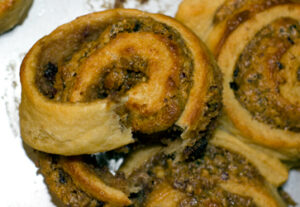
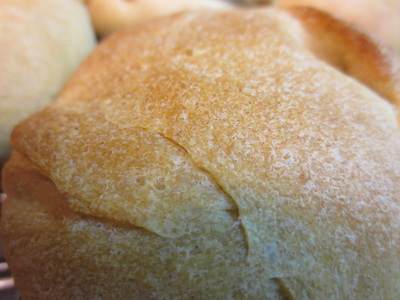 This is going to be a long post for a very simple recipe. I want to try to convince you that making homemade bread, especially rolls (pictured), is so simple that, as Peg Bracken says, it would “have any cordon bleu chef pounding his head with his omelette pan.” People are always so amazed when they realize that you’ve made bread, as if you’d taken out your own appendix. So read on,