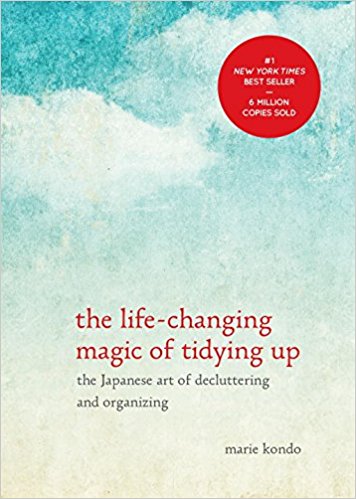
 Yet another blog post generated from a Gretchen Rubin idea. (I guess at some point I’ll have to start paying her a commission.) She had an interview this week with Marie Kondo, the incredibly successful organizer/declutterer who has now written a second book, Spark Joy. I just went online and downloaded the audiobook from the library, so expect to hear about my going on another ninja clearing-out raid in the days to come, the same thing that happened when I read Kondo’s first book, The Life-Changing Magic of Tidying Up

 Mr. Money Mustache: Financial Freedom through Badassity,
 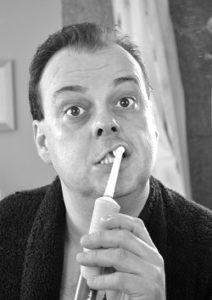 Yesterday I took on the Big Question of free will vs. fate. Today I’m talking about cleaning out my Sonicare toothbrush. No one can accuse me of being in a rut!
 I seem to be on a tool tear, as it were. Over the past several weeks I’ve written about using Scrivener as a writing tool, my little laptop as a bill-paying tool, and habits as tools to help lend structure to my life. But . . . I’ve also emphasized that tools don’t do the work for us. So I’m dedicating this post to two non-tool-users, Woody Allen and K. Lee Scott
 Another habits principle is that you’re more likely to do what’s convenient and less likely to do what isn’t. It struck me just a day or two ago that I had a tool that I loved, that was extremely convenient and which I could use more: my darling little laptop. You can see in the picture how small it is. [Note: this is a stock image; as with so many other pictures, this one was lost in the website move. And now, as I re-do this post, that little laptop is long gone–I think I’m o the third one now.] I carry it around with me from room to room just as some people carry around their smartphones. [Again, a further note: I certainly now have a smartphone!] A couple of days ago I sat down to pay some bills and realized that I hadn’t balanced the checkbook for some time. I’ve still been using a paper check register to do this, and I thought, Why don’t I use my laptop? I googled “virtual check register” and found something called “checkbook.com.” I also used the strategy of the “clean slate,” another Gretchen Rubin idea. I didn’t bother with going back and checking every transaction since the last time I did the balancing act; I don’t think I’ve ever found a mistake on the bank’s side, so what was the point? The important thing is for me to have some kind of backup information, although I guess it would be fine just to rely on the bank’s online statement. I may re-think the issue in the future, but at least for now I can just enter items online and see the balance computed for me. I’m also going to go ahead and start actually paying the bills online, something I’ve resisted doing for some reason. Why should I go through the inconvenient process of writing out checks, entering them in the register, putting the check and the payment slip in an envelope, hunting up a stamp and a return address label, and then mailing them? Hmmm. As soon as I get finished writing this post I’ll go to the bank website, pay off yesterday’s credit card charges and pay the two bills I have right now. One is a medical bill that will have to be paid by check, but the other is the monthly phone/internet charge, so I can set up online bill pay for that. (I realize that the preceding may sound like I’m still using a quill pen and paying bills with bags of coins, but I’m really trying to become more hip and happening!) I’ve been wanting to establish the habit of keeping up with our finances on a daily or semi-daily basis; the use of a convenient, familiar, well-liked tool will help me do that.
 I’m concentrating right now on building happiness by establishing good habits within the limits of my character. This emphasis has grown out of Gretchen Rubin’s new book that I wrote about yesterday. I’ve been sharing my struggles to put accountability structures in place that will work with my obliger tendency, but I’m realizing that for some habits I’m just going to have to use some other prod or prods. I’ll be writing about these ideas over the next posts. I love putting my mind to a problem and finding a solution once I realize that there is a problem.