 I first made this recipe from America’s Test Kitchen for a huge open house we had. My son and I had made up dozens of these the day before, and then all we had to do was to bake them as needed. I made somewhat of a miscalculation during the party, thinking that we didn’t need that last panful, and then people scarfed up all the ones I’d baked and it was really too late to put in the rest, as they have to bake about 30 minutes. So be sure to make plenty. I’m saying that this recipe will make a dozen empanadas, but that yield will depend on how many optional ingredients you include. If you’re adding all of the add-ins you’ll want to make extra dough.
A Simple Book on Simplicity
 Freedom of Simplicity: Finding Harmony in a Complex World by Richard J. Foster, originally published in 1981; now available in several formats through Amazon, Google Books, and Barnes & Noble, to name the biggies. Foster is or has been a theologian, teacher, pastor and writer, and (I just found out) lives near Denver.
We’ve had the 1989 paperback version of this book on our shelves for many years; I think Jim brought it into the marriage. For some reason I just recently decided to read it and have been challenged and rebuked by many of its ideas. Foster is well known for an earlier book, Celebration of Discipline, with this book being somewhat of a followup.
Never Say “For Now”
 It would be great if I would follow my own advice. In the chapter on “The Big Effect of Small Actions” in my book I talk about how important it is to keep up on small jobs that will inevitably balloon into large ones if neglected. (Have you noticed the new “Resources” tab on this website? You can now buy an ebook version of Intentional Happiness directly from this website as well as buying the paperback or Kindle version from Amazon.) Every time I went into the “downloads” section of my library, which is where I put the images from my wonderful image service, Dollar Photo Club, I would get irritated. ‘What a mess!’ I’d think.
My Abstainer Tendencies Get Me into Trouble
 If you’ve been reading this blog for any length of time, you know that I’m a huge fan of Gretchen Rubin. I’ve read her three books on happiness and habits numerous times, and I hear my voice in my head as I do so. One of her key insights, especially relevant when it comes to healthy eating habits, is the divide between what she calls “moderators” and “abstainers.” (She and her sister have started doing a weekly podcast called “Happier with Gretchen Rubin,” and I was tickled that today’s episode includes a segment about whether or not to keep ice cream in the freezer which centers around this very divide.) I am mostly an abstainer, just like the listener who called in with the ice cream question, which means that I do better at controlling bad habits when I just abstain entirely, or almost entirely, from them. I do find it possible to eat just one chocolate truffle. And my little “eat only one dessert a week” mantra also works pretty well. BUT . . . if I overstep those bounds very much at all then I plunge into trouble. I can’t break the rules just a little bit; I break them a lot.
A Hearty Vegetarian Salad
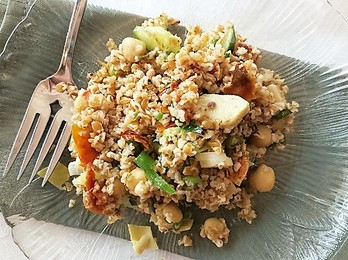 I wanted to make a substantial version of tabbouleh for vegetarians. You can do pretty much what you want with this. I give a list of possible ingredients and you can add or subtract at will and to taste. Most tabbouleh recipes are very heavy on the chopped parsley, almost as if that ingredients is standing in for lettuce, but you don’t have to add that much. You could even, if you wanted to, add some shredded cooked chicken, if you have any sitting around that you want to use up, but this is such a good dish for vegetarians (and even vegans) that it’s probably good to leave it meat-free.
The Joy of Being Heard
 “What matters is not what is said, but what is heard.”
“I’m only responsible for what I say, not for what you understand.”
“If your students haven’t learned, you haven’t taught.”
Which is these statements do you agree with? I was often reminded of the third one when I was a teacher myself, and while there’s some truth in it the students’ responsibility is ignored. I can’t make my students learn.The middle statement is just plain wrong; I’m always getting myself into trouble by saying things that are misunderstood. But the first statement is a valid principle, I think. I had an experience yesterday in which I was truly heard, and because that happened I am probably on the way to overcoming a long-standing medical problem.
Is There a Positive Side to Tragedy?
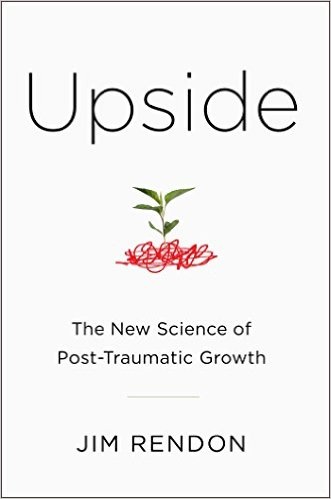 Upside: The New Science of Post-Traumatic Growth by Jim Rendon, Touchstone Books, 2015. Available through Amazon, Barnes & Noble, and other retailers. Visit his author website at jimrendon.com.
Wouldn’t it be sort of obvious that we almost always learn and change the most through difficult times? It is, but if you think about it the heaviest emphasis in the past couple of decades has been on the negative consequences of trauma, especially with the official diagnosis of PTSD—post traumatic stress disorder. And there is no doubt that those who have experienced pain, injury, disaster, and loss often, indeed almost always, suffer from all kinds of lingering issues, from flashbacks to sleeping problems to depression. Yet we know that we also grow from those experiences. As I read this book I realized that there has often been an either/or, all-or-nothing school of thought about trauma. Either I learn and grow, or I am a lesser person than I was. The message of this book is that it can be both. The author, veteran journalist Jim Rendon, begins by telling about his father, a Holocaust survivor. On the one hand, the negative one, his father sleeps poorly and is sometimes consumed by anxiety. On the other hand, the positive one, he is full of humor and compassion. “All that he lived through, all that he survived, all that he lost, left him changed and some of those changes have been truly positive” (xv).
Doing It Yourself, Part Two
 We often tend to think of luxury in terms of being waited on or having others do work we find irksome. I’ll think sometimes of how nice it would be to have someone in to clean this house so that I wouldn’t have to worry about it and could just get on with my writing. I know two excellent cleaning women whom I like and respect very much and who could probably use the work. We can afford to pay them. That’s not the issue. But every time I get close to deciding to hire them I pull back. Cleaning house is excellent exercise; no one can sit at a computer for too long without needing to get up and do something else. (Well, no one except my son, whose computer-sitting-tolerance seems to be boundless.) Plus, as we all know if we’ve ever hired anyone to do something, handing the job over to an employee includes the dreaded idea of management. What do you want him to do? How do you want it done? How much time should it take? How much will you pay?
Who’s Your Sugar?
 Fed Up, a documentary produced by Laurie David (who also produced An Inconvenient Truth), directed by Stephanie Soechtig, and narrated by Katie Couric. Available through Amazon, YouTube, and Netflix. All of these links are to paid services. You can watch a trailer here on YouTube.
I owe my viewing of this documentary to the fact that I got bored watching an episode of Marvel’s Agents of S.H.I.E.L.D. and started browsing. Since Netflix knows all, the documentaries I was presented with mostly had to do with food, and this one sounded interesting. I started watching and was completely captivated; about a week later I re-watched it, this time with Jim and Gideon.
Doing It Myself Makes Me Happy!
 And it also saved me $300. Not bad for around three hour’s work, or $100 an hour. Hey, that’s lawyer pay!
As you can see from the picture, we have a beautiful Oriental rug in our entryway. We bought it 15+ years ago in one of those infamous “going out of business” sales that seem to be a constant event in rug stores. This one was happening because (we were told, anyway) the owner had leukemia and was having to sell the store. Maybe it was true; I certainly don’t want to sound unsympathetic. Be that as it may, we took some time going through the massive piles on the showroom floor and spotted this one. I fell in love on the spot. The colors were so different from the typical blues and reds. And it was only $1,200.00, which I think was a pretty good deal. I loved looking at all the different colors, all so artistically combined.